


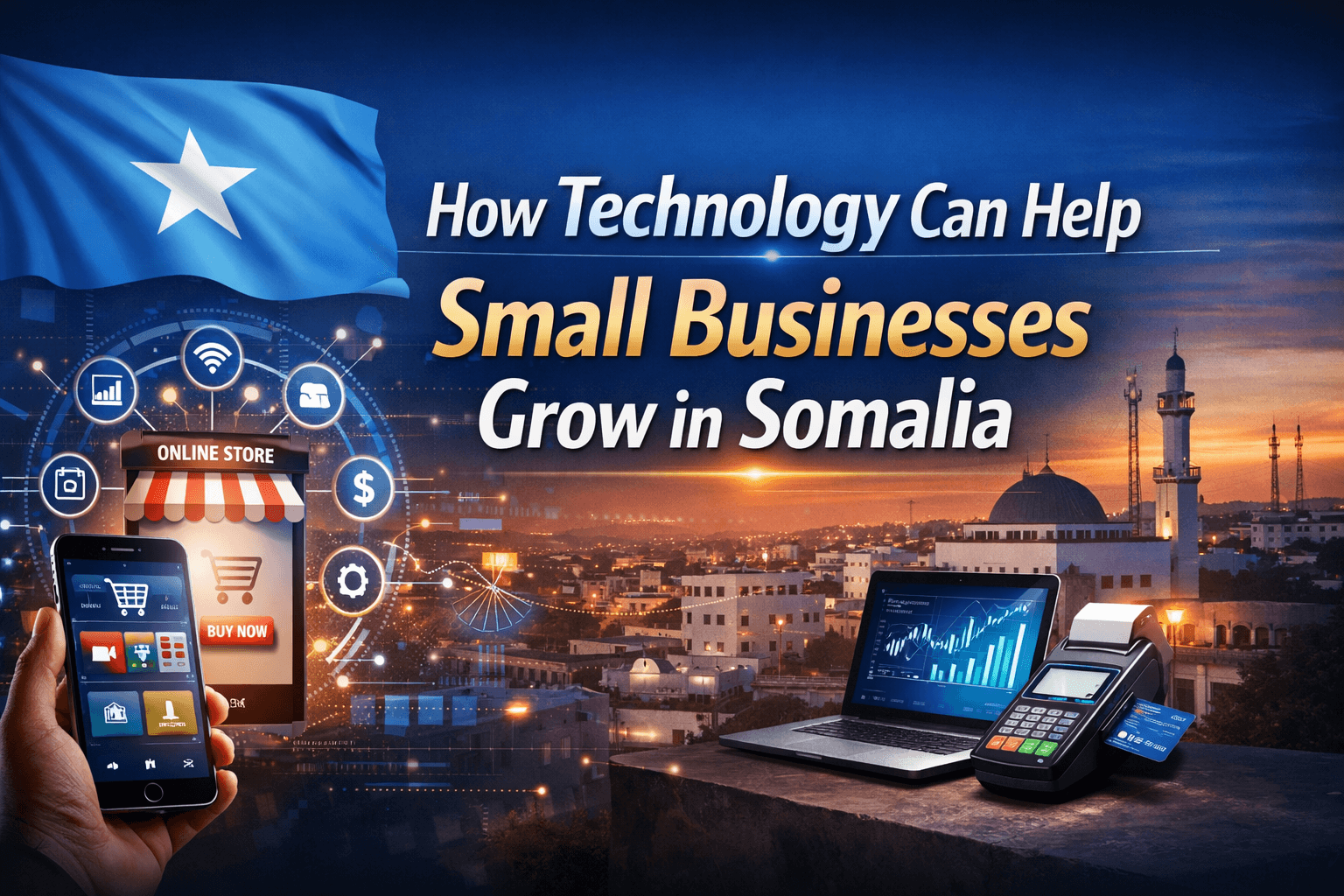
The Digital Metamorphosis: Transforming Somali SMEs for 2026 and Beyond
The Somali economic landscape is currently undergoing a profound structural metamorphosis, transitioning from a traditional, informal trade-based system to a digitally integrated market economy. This evolution is driven by the necessity of resilience in a fragile institutional environment and the entrepreneurial vigor of a population that has historically relied on trust-based networks to facilitate cross-border and domestic commerce. While the formal state structures were historically weakened by decades of conflict, the private sector—specifically the telecommunications and financial technology industries—effectively leapfrogged traditional development stages to establish one of the most sophisticated mobile payment infrastructures globally.
As of early 2026, the digital landscape in Somalia is characterized by a population of 19.3 million, with 11.3 million active cellular mobile connections, representing 58.3 percent of the total population. This connectivity serves as the foundational layer upon which small and medium-sized enterprises (SMEs) are building scalable business models that reduce transaction costs, expand customer reach, and automate previously labor-intensive operations.
The significance of this transition cannot be overstated for the small business owner, who often operates in an environment with limited access to traditional banking, erratic electricity, and logistical hurdles. Technology acts as a leveler, providing micro-enterprises with tools that were previously reserved for large conglomerates. The widespread adoption of mobile technology has enabled businesses to reach new customers, expand their markets, and streamline operations, leading to increased efficiency and productivity.
The Macro-Digital Infrastructure and Connectivity Paradigm
The efficacy of technology as a growth engine for Somali SMEs is inextricably linked to the underlying telecommunications infrastructure. The number of internet users in Somalia reached 10.7 million at the start of 2026, with an internet penetration rate of 55.2 percent. This represents a significant increase from previous years, bolstered by the expansion of fiber optic networks and the recent introduction of low-earth orbit satellite services like Starlink in August 2026.
The infrastructure is supported by two major international subsea cables: the East Africa Submarine Cable System (EASSy) with a capacity of 10 Tb/s and the DARE1 subsea cable. These connections have enabled a dramatic improvement in data speeds; for instance, the download speed of typical fixed internet connections in Somalia increased by 67.4 percent in the twelve months leading to January 2026.

| Metric | Value | Year-on-Year Growth |
|---|---|---|
| Total Population | 19.3 Million | +3.5% |
| Mobile Connections | 11.3 Million | +8.5% |
| Internet Users | 10.7 Million | +3.5% |
| Social Media Identities | 3.05 Million | +4.7% |
| 4G Coverage | 64% | Stable |
| 5G Coverage | 5% | Emerging |
The disparity between mobile connections (58.3 percent penetration) and social media usage (15.8 percent of total population) suggests that while many Somalis use mobile devices for essential services like voice calls and mobile money, there remains a massive untapped potential for SMEs to move their marketing activities into the social media sphere. Furthermore, the urban-rural divide remains a factor, with 48.8 percent of the population living in urban centers where digital infrastructure is more concentrated, compared to 51.2 percent in rural areas.
Fintech as the Engine of Small Business Scalability
Somalia is frequently cited as one of the world's first "cashless" societies. Mobile money has filled an institutional vacuum, with an estimated 73 percent of Somalis over the age of 16 using these services monthly. Platforms such as EVC Plus (Hormuud), e-Dahab (Somtel), and ZAAD (Telesom) have moved beyond simple transfers to become comprehensive financial management tools. The scale of this market is immense, with approximately 650 million transactions totaling $8 billion occurring annually.
| Platform | Provider | Primary Reach | Key SME Features |
|---|---|---|---|
| EVC Plus | Hormuud Telecom | South-Central Somalia | Merchant payments, salary disbursement, tax collection |
| ZAAD | Telesom | Somaliland | Cashless ecosystem, university and employee payments |
| e-Dahab | Somtel | Nationwide | Remittance integration, cross-border trade settlements |
| Waafi App | Hormuud/Partners | Regional/International | Unified banking, communication, and real-time capital moves |
| eDirBixi | Nationwide | Interoperable | Inter-wallet transfers, international payment gateways |
The launch of the Somalia Payment Switch (SPS) and the Somalia Instant Payment System (SIPS) in January 2026 marks a turning point for interoperability. By introducing the SOMQR standard, the Central Bank of Somalia is enabling SMEs to accept payments from different banks and mobile money operators through a single, universal QR code.

Digital Marketing and the Social Commerce Revolution
Research indicates that platforms like Facebook and WhatsApp are particularly powerful for SMEs because they utilize "tie-strength amplification". Technology doesn't just create new connections but strengthens existing "weak ties" in the community. WhatsApp is often described as the "storefront" for micro-enterprises, where status features and broadcast tools are repurposed into an informal e-commerce channel.
| Platform | User Base | Primary SME Use Case | Impact on Growth |
|---|---|---|---|
| 1.5 - 2.5 Million | Community ads, brand presence | High reach, established trust | |
| 1.8 Million | Direct sales, support, auctions | High conversion, low data cost | |
| TikTok | 1 Million+ | Viral marketing, brand storytelling | Explosive awareness, youth appeal |
| ~522,000 | Visual branding, fashion | Niche luxury, diaspora appeal |
Operational Efficiency Through Automation and Software
Beyond marketing, technology is transforming internal operations. Many businesses are moving away from manual bookkeeping toward Point of Sale (POS) systems. Systems like Juleb POS, Movetech, and Managerium Retail ERP are becoming the standard for urban retail shops and pharmacies.
| Software / System | Target Segment | Key Advantage |
|---|---|---|
| Juleb POS | Pharmacies, Boutique Shops | Compliance tracking, cloud-sync |
| Movetech POS | Supermarkets, Restaurants | Touchscreen, bulk SMS marketing |
| Managerium ERP | Growing SMEs | All-in-one inventory and HR |
| Shopify POS | Multi-channel Retailers | Online and physical sync |
Logistics and the Last-Mile Delivery Bridge
Startups like Gulivery, Rikaab, and Suuqa App are creating localized versions of the "Amazon model" tailored to the specific geographical and security realities of Mogadishu and Hargeisa. Gulivery enabled over 145 businesses to reach customers efficiently, while Rikaab has acquired over 100,000 clients.
| Platform | Type | Primary Benefit | Impact Scale |
|---|---|---|---|
| Rikaab | Super App | Unified rides, food, and e-commerce | 100k+ clients, 5k+ drivers |
| Gulivery | Delivery Service | On-demand door-to-door delivery | 1,200+ monthly deliveries |
| Suuqa App | Marketplace | Buy/sell used goods, hire services | Local community focus |
| Saami Online | E-commerce | Delivering electronics/clothing | 90k+ social media followers |
Ecosystem Support and Skill Development
Innovation hubs such as iRise Hub and SIMAD iLab act as catalysts. iRise has impacted over 400 startups and facilitated $10 million in investment. SIMAD iLab focuses on equipping youth with industry-relevant skills like graphic design and digital marketing.
- 2,000+ Youth Trained
- 750 Jobs Created
- 68 Startups Incubated
- $330M MSMEs Accelerated (Value)
Real-Life Success Stories
- Ayaan Abdirahman Ahmed: Founded 'Astaansan' digital agency after self-teaching via YouTube.
- Nimco Happy: Leveraged TikTok for global viral success ('Isii Nafta').
- Samira Mohammad: Modernized dairy production through local cheese manufacturing technology.
- Saami Online: Built a nationwide electronics platform starting with $25 and a laptop.
Government Policy and the 2026-2030 Roadmap
The "Digital Transformation Strategy 2026-2030" aims to align national digital initiatives. Objectives include Infrastructure Expansion, Digital Inclusion for health and agriculture, Job Creation for youth (75% of population), and Interoperability via the Somalia Payment Switch.
Challenges and Future Outlook: AI
Structural barriers remain: expensive fixed-line internet, high energy costs (lack of national grid), and a cybersecurity preparedness score of 37.39. However, the 2026 horizon looks toward Predictive Analytics, Voice-First Technology in Somali, and Global Wallet Integration.
| Area of Growth | Technological Solution | Benefit for SMEs |
|---|---|---|
| Customer Reach | TikTok, Facebook, WhatsApp | Global diaspora access, viral awareness |
| Financial Mgmt | EVC Plus, e-Dahab, Waafi | Cashless transactions, safe salary payments |
| Operational Efficiency | Juleb POS, Movetech, Shopify | Automated inventory, remote monitoring |
| Logistics | Rikaab, Gulivery, Suuqa | On-demand last-mile delivery, order tracking |
| Skill Acquisition | iRise Hub, SIMAD iLab | Low-cost training in coding/marketing |
| Cost Reduction | Cloud Computing, AI | Lower overhead by replacing physical offices |
In conclusion, the fusion of traditional Somali business acumen with modern digital tools is creating an economic engine that is robust, inclusive, and globally connected. For the Somali business owner, the question is no longer whether to adopt technology, but how quickly they can integrate these tools to stay competitive.